


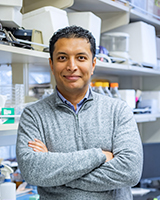
Assistant Professor, Departments of Neurology and BioEngineering
tasfaout@uw.edu
Phone: 206.616.7087
Office: S265, South Building
South Lake Union Campus
850, Republican Street
98109, Seattle WA
Hichem Tasfaou
Our work addresses a fundamental limitation in gene therapy: the inability to deliver large therapeutic genes using conventional methods. By developing scalable delivery strategies, such as multi-vector systems, mRNA platforms, and protein reconstitution technologies, our research programs enable the restoration of full-length, functional proteins in conditions such as Duchenne muscular dystrophy and other muscular diseases. These advances help move gene therapy toward broader, more durable, and clinically translatable solutions for previously intractable diseases.
Muscular dystrophies
Congenital myopathies
Viral vectors
Non-viral delivery systems
Protein trans-splicing
Split inteins
A central focus of our current work is addressing a major limitation in gene therapy: the efficient delivery of large, disease-relevant proteins that exceed the packaging capacity of conventional viral vectors, particularly adeno-associated virus (AAV). To overcome this challenge, our group is developing and optimizing alternative delivery platforms, including chemically modified mRNA delivered via lipid-based formulations, as well as protein reconstitution strategies based on split inteins and trans-splicing across multiple vectors.
These approaches have enabled comprehensive preclinical studies in models of Duchenne muscular dystrophy (DMD), limb-girdle muscular dystrophy R2 (LGMDR2), and other congenital myopathies. Collectively, this work aims to advance scalable and clinically translatable solutions for diseases caused by mutations in large genes that have historically been difficult to target.
Following my postdoctoral training, I joined the University of Washington faculty, where I currently serve as Assistant Professor in the Departments of Neurology and Bioengineering. I am also a faculty member of the Institute for Stem Cell and Regenerative Medicine and the Wellstone Research Center for Muscular Dystrophies. My career progression reflects a continuous focus on translational research, advancing from clinical pharmacy training to leading efforts in the development of innovative genetic therapies for neuromuscular diseases.
2024: MDA Career Development Award (USA)
2024: Jaconette L. Tietze Young Scientist Research Award, Seattle (USA)
2023: European Society of Gene & Cell Therapy meeting Travel Award, Brussels (Belgium)
2023: American Society of Gene & Cell Therapy meeting Travel Award, Los Angeles (USA)
2022: Young Investigator Award, Myology2022 meeting, Nice (France)
2018: Young Investigator Award, Bettencourt-Schueller Foundation, Paris (France)
2018: Merit Award, Philippe Foundation (USA)
2018: Outstanding PhD thesis prize, Society of Biology of Strasbourg-Transgene (France)
2016: Best talk prize, Department of Translational Medicine and Neurogenetics retreat, Mont St Odile (France)
2013: MRT PhD fellowship, Ministry of Research and Technology, Strasbourg (France)My
Tasfaout H, Reyes TR, McMillen T.S, Regnier M, Chamberlain JS: Efficient expression of full-length dystrophin using split intein and myotropic AAV. Journal of Clinical Investigation (2025)
Tasfaout H, Halbert CL, McMillen T.S, Allen JM, Reyes TR, Flint GV, Grimm D, Hauschka SD, Regnier M, Chamberlain JS: Split intein-mediated protein trans-splicing to express large dystrophins. Nature (2024)
Bengtsson NE, Tasfaout H, Hauschka SD, Chamberlain JS: Dystrophin Gene-Editing Stability Is Dependent on Dystrophin Levels in Skeletal but Not Cardiac Muscles. Molecular Therapy (2021)
Ross JA, Tasfaout H, Levy Y, Morgan J, Cowling BS, Laporte J, Zanoteli E, Romero NB, Lowe DA, Jungbluth H, Lawlor MW, Mack DL, Ochala J: rAAV-related therapy fully rescues myonuclear and myofilament function in X-linked myotubular myopathy. Acta Neuropathologica Communications (2020)
Buono S, Ross JA, Tasfaout H, Levy Y, Kretz C, Tayefeh L, Matson J, Guo S, Kessler P, Monia BP, Bitoun M, Ochala J, Laporte J, Cowling BS: Reducing dynamin 2 (DNM2) rescues DNM2-related dominant centronuclear myopathy. Proc Natl Acad Sci U S A. (2018)
Tasfaout H, Lionello VM, Kretz C, Koebel P, Messaddeq N, Bitz D, Laporte J, Cowling BS: Single Intramuscular Injection of AAV-shRNA Reduces DNM2 and Prevents Myotubular Myopathy in Mice. Molecular Therapy (2018)
Cowling BS, Prokic I, Tasfaout H, Rabai A, Humbert F, Rinaldi B, Nicot AS, Kretz C, Friant S, Roux A, Laporte J: Amphiphysin (BIN1) negatively regulates dynamin 2 for normal muscle maturation. Journal of Clinical Investigation (2017)
Tasfaout H, Buono S, Guo S, Kretz C, Messaddeq N, Booten S, Greenlee S, Monia BP, Cowling BS, Laporte J: Antisense oligonucleotide-mediated Dnm2 knockdown prevents and reverts myotubular myopathy in mice. Nature Communications (2017)