


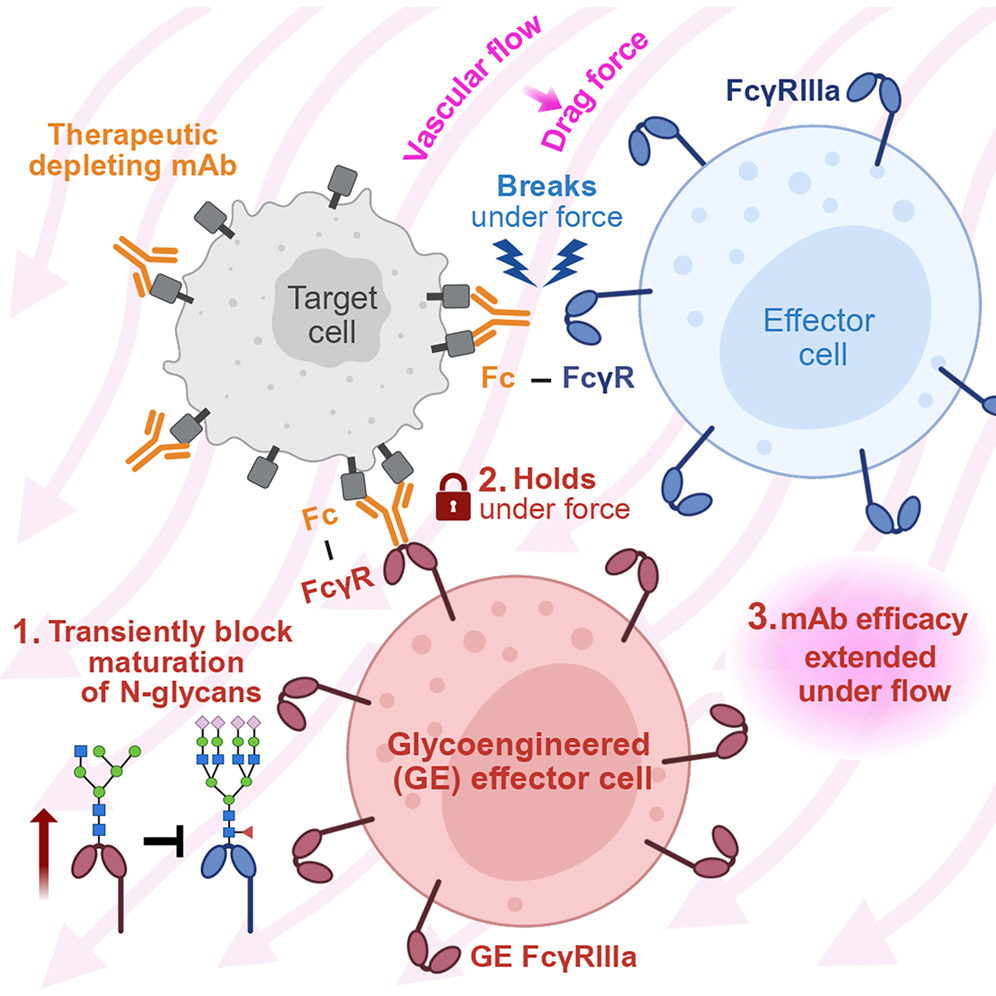
 UW Bioengineering Professor Wendy Thomas and Stanford Professor Taia Wang reveal that mechanical forces can shape how antibodies interact with immune cells, opening new ways to think about cancer treatments.
Stanford University’s Professor Taia Wang and her team faced a puzzle.
Their research has shown that re-engineering the way sugars attach to proteins through a process called glycosylation can impact the efficacy of therapeutic monoclonal antibodies (mAbs). These drugs coat pathogens and recruit elements of our immune response, like T cells and other effector cells, to join the fight. In recent work led by postdoctoral researcher Bowie Cheng, they showed that a drug called swainsonine could be used to similarly alter the sugars on immune cells themselves and improve their ability to kill mAb-coated cancer cells.
But they couldn’t fully explain why the strategy worked as well as it did.
“There are surely many mechanisms behind the increased activity we see when administering swainsonine with anti-tumor mAbs, but something didn’t add up to fully explain the powerful treatment effect we were achieving,” Wang said. “We saw only small changes in mAb activity when we tested the strategy in a dish, but huge changes when we tested it in live animals. This suggested that some aspect of whole-body physiology was critical to the treatment’s success.”
Wang’s team decided to use that discrepancy to test a new hypothesis. Perhaps the fluid flow around tumor cells applied a mechanical force that affected how antibodies bound their receptors, enabling the outsized treatment effect.
With that in mind, she turned to the scientific literature to find an expert in the biomechanics of molecules who might lend a hand. She was quickly drawn to UW Bioengineering’s Professor Wendy Thomas, who had long studied how fluid flow influences interactions between proteins.
Their work together was published in Immunity this July.
“Wendy is doing beautiful work in this area,” Wang said. “She was an ideal collaborator, and she jumped right in. We knew we had an opportunity through our combined expertise to test a new idea in antibody biology.”
Thomas felt the same pull. “We had this complementary expertise and shared interest,” she said. “There was no conventional wisdom, so we got the opportunity to ask ourselves ‘What doesn’t the conventional wisdom address?’ That’s an exciting spot to be in.”
Their teams applied an existing biomechanical research technique to show that swainsonine dramatically increased the ability of immune cells to hang on to mAbs under fluid flow that mimics conditions in the human body.
Perhaps more significantly, they established for the first time that mechanical forces can change how antibodies interact with their receptors independent of their binding strength, which is known as affinity. This opens a new potential avenue to improve these crucial immunotherapies by tuning their activity for specific fluid flow conditions.
“This is a new observation,” Wang said. “Mechanical forces can change this interaction, and that opens the possibility of a parallel track for designing next-generation engineered monoclonal antibodies.”
Multiple Dimensions
Monoclonal antibody treatments have been around since the 1980s. The first were designed to mitigate the rejection of transplanted organs. Hundreds have been approved since to treat a range of cancers like leukemia, lymphoma, and several solid-tumor cancers like HER2-positive breast cancer.
But the efficacy of these treatments varies widely, and patients often develop resistance. This indicates that we don’t fully understand how the activity of mAbs is regulated. “Critical knowledge gaps likely exist in multiple dimensions,” the team wrote in Immunity. “Addressing these gaps may reveal new opportunities to enhance efficacy and overcome current therapeutic limitations.”
In this study, immune cells treated with swainsonine showed only a 20 percent increase in binding affinity for antibodies, yet reduced tumor burden – the amount of cancer present – by about 80 percent in animal models. That gap between a modest affinity change and a large functional effect is what first told the team something beyond affinity was at work.
“All kinds of mechanical processes are at play that aren’t there in the assays we typically use in the laboratory to study antibodies,” Wang said. “This study provided a reason to ask the question – is it possible that physiologic forces can change the way antibodies interact with their receptors?”
With Thomas and UW Bioengineering PhD alumnus Casey Kiyohara, the team set up and used a fluidics platform to study how mechanical forces in the circulatory system cause drag on immune cells and impact how they interact with mAbs. The platform allows them to adjust the rate at which fluid is moving, changing the biomechanical force between the immune cells and an antibody-coated surface that models an antibody-coated tumor. Most significantly, it lets them ask how much flow it takes to detach an immune cell from that surface.
“We were watching these mechanical processes for the first time, and could observe how force caused the immune cells to deform as they clung to the surface, and eventually detach,” Thomas said.
These biomechanical measurements let the team compare how two very different interventions – swainsonine treatment of immune cells, and re-engineering the sugars of the antibodies themselves – each affected binding behavior under flow.
“That’s what was so cool,” Thomas said. “One of these increases affinity of antibodies to immune cells a lot, and the other doesn’t. But both helped the immune cells cling to the surface under flow, and both mechanisms likely helped immune cells kill cancer cells.”
In other words, the platform revealed that resistance to mechanical force is one dimension shaping antibody interactions with immune cells. And that insight expands the questions cancer researchers and drug developers can now ask.
“We’ve opened up a new set of exciting questions about these biomechanical interactions,” Thomas said, “and introduced a new way to think about improving cancer treatments.”