


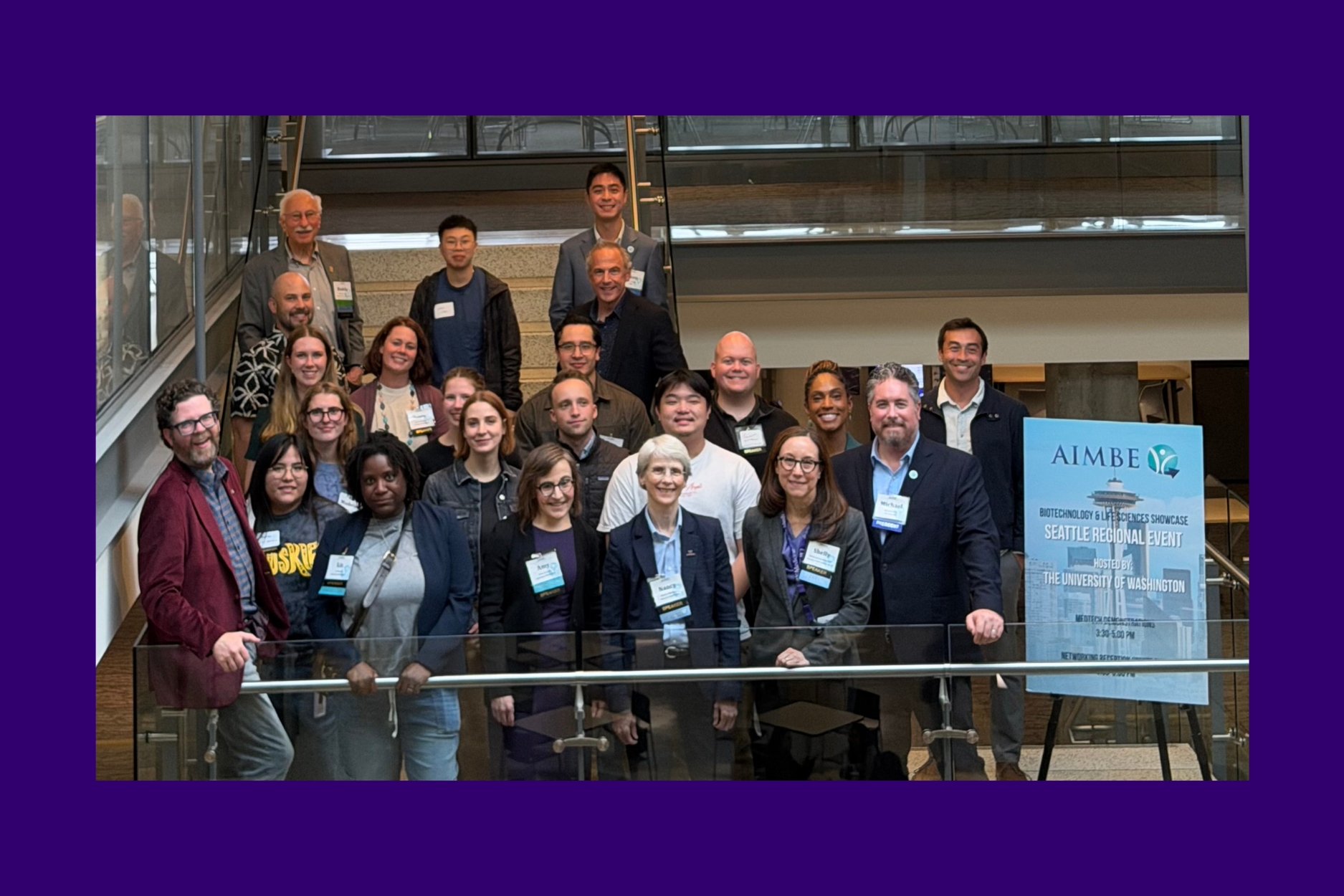
 Lawmakers, educators, researchers, and members of the American Institute for Medical and Biological Engineering (AIMBE) took an in-depth look at UW Bioengineering research in early October, during an afternoon visit to campus. AIMBE hosted the event as part of its annual regional advocacy series.
“We were honored to have members of Congresswoman DelBene’s team and Congressman Smith’s team be a part of the day. Our relationships run deep, and the advocacy they provide reminds everyone of our faculty, students, and alumni’s powerful impact,” said Sang Han, Deputy Director of UW’s Office of Federal Relations. AIMBE President Michael King, who is a bioengineering professor at Rice University, attended, as did representatives from the Allen Institute and United Imaging.
Visitors saw a range of new technologies from across the department, such as portable dialysis approaches, imaging to better manage eye disease, biosensors to track the body’s response to drug treatments, point-of-need diagnostic tools, and devices to track how sex-dependent hormonal changes impact tissue regeneration.
“Our regional advocacy events underscore the importance of federal funding on the local economy, universities, and companies. Seattle and the University of Washington are vibrant contributors to a state that has led in medtech and healthcare for decades. This work is crucial, and AIMBE is always pleased to partner with our members to highlight it,” said King said.
More than 35 UW Bioengineering core, adjunct, and affiliate faculty members are AIMBE Fellows and AIMBE Emerging Leaders. Professors Amy Orsborn (an AIMBE Emerging Leader) and Michael Regnier (an AIMBE Fellow) organized the event locally. It also included demonstrations by members of the Department of Mechanical Engineering’s faculty and local startups.
“Some of the best ideas begin with a single conversation, and all of the best ideas are driven by the people we serve throughout the community. Our collaboration with AIMBE on this event supported those conversations beautifully,” said Department Chair Princess Imoukhuede.
Demonstrations and lab tours at the AIMBE regional advocacy event included:
- Atomic-Scale Simulations to Understand Genetic Diseases, Professor Matthew Childers
- Human Mobility and Assistive Robots, Professor Kim Ingraham (Department of Electrical & Computer Engineering)
- Self-Powered Microfluidics: Medication Monitoring at the Point of Need, Professor Ayokunle ?lánrewájú
- Brain-Computer Interfaces to Restore and Rehabilitate Movement, Professor Amy Orsborn
- Portable Dialysis, Professor Buddy Ratner (AIMBE Fellow) and Kuleana Technology, Inc.
- Sensor Systems for Robotics, Medical Devices, and Human-Computer Interaction, Professor Joshua Smith (Department of Electrical & Computer Engineering)
- Cellular Force Measurements for Advancing Human Health, Professor Nate Sniadecki (Department of Mechanical Engineering)
- Bioprinting Human Organs, Professor Kelly Stevens (AIMBE Fellow)
- Optical Coherence Tomography and OCT Angiography for Eye Health, Professor Ricky Wang (AIMBE Fellow)
- Cellular Biosensors to Predict Drug Responses, Professor Elizabeth Wayne (AIMBE Emerging Leader