


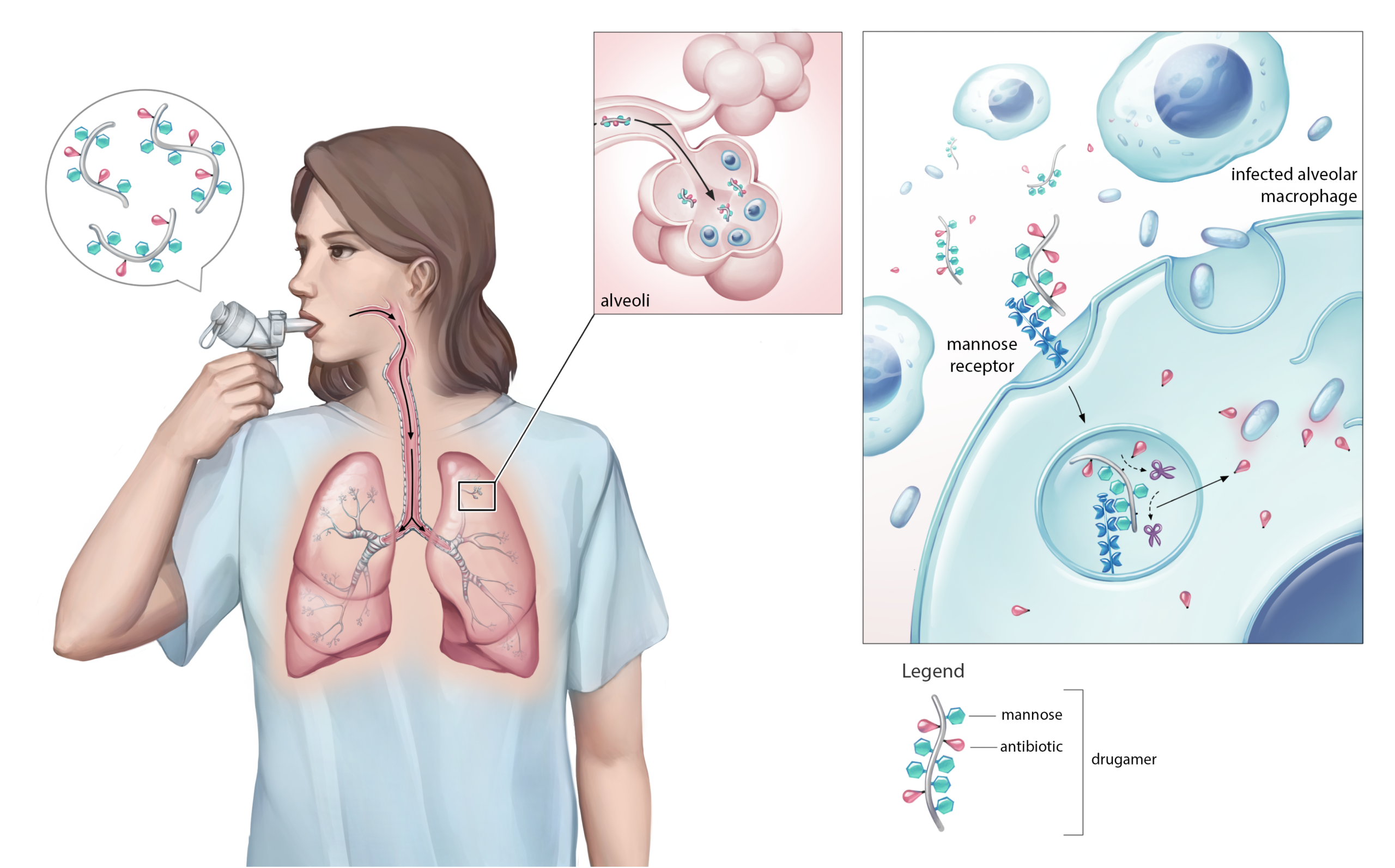
 UW Bioengineering’s Professor Patrick Stayton and clinical colleagues Professors Eoin West and Shawn Skerrett in the UW School of Medicine are developing a new means of treating pneumonia. If successful, the inhaled drug would improve therapy and prevent common side effects and protect the gut microbiome.
The work is backed by Wellcome Leap’s $50 million Focused Antibiotics program, which addresses the grand challenge of delivering antibiotics to treat infections while sparing the gut microbiome and reducing drug resistance.
The project draws on long-standing partnerships between the UW College of Engineering and the School of Medicine, which jointly house the Department of Bioengineering. The engineering challenge is to build multiple pharmaceutical functions into one new drug, while achieving manufacturability at high global scales and with cost effectiveness. UW has been a leader in developing innovative pulmonary drugs, helping this program deliver better therapeutics to patients who need them.
“Pneumonia is generally the leading infectious cause of death in the United States, with approximately 1.5 million hospitalizations annually. Lower respiratory infections globally cause about 2.5 million deaths per year, with especially high impacts in lower resource populations,” Stayton said. “We hope to provide better therapeutic options for patients across an inter-connected world when it comes to pulmonary infectious disease and antibiotic resistance.”
The standard treatment is based on a common pair of drugs that have been paired with one another for decades, amoxicillin and the beta-lactamase inhibitor clavulanate. It’s an effective combination that’s prescribed more than 30 million times per year in the United States alone, according to the CDC’s Outpatient Antibiotic Prescriptions Report.
Its frequent use and efficacy come at a significant cost. Taken as a pill, the antibiotic kills bacteria in the microbiome unnecessarily and leaves other, drug-resistant bacteria free to reproduce. This “resistance factory,” as Wellcome Leap calls it, allows pathogens to thrive. People whose guts become overloaded with that resistant bacteria are 20 times more likely to develop an infection that does not respond to amoxicillin in the future.
“A pill lands in the gut first, where it hits the microbiome,” Stayton said. “That is where patients’ digestive side effects come from, and it is where resistance can get generated, because you are exposing a dense community of bacteria that was never the target. From there the drug goes systemic and travels throughout the body. Only a small fraction reaches the lung, which is why the doses have to be so high. We are delivering into the lung directly and hitting efficacious levels with hopefully fewer and lower doses, so the infection gets more drug and the microbiome gets far less.”
West and Skerrett, along with the larger pulmonary antibiotic leadership at UW, bring the patient-needs experience and pneumonia models that move a new drug candidate faster toward human trials.
“We’ve come to expect collaborations like these, but it doesn’t make them any less powerful. It only increases their impact and assures that there are more great things to come from this team and other teams,” said Professor Nancy Allbritton, Dean of the UW College of Engineering. “The Department of Bioengineering stands out and succeeds, in no small part, because of the way it bridges our College of Engineering and UW Medicine.”
“Wellcome Leap describes their investments as ‘optimized to deliver breakthroughs.’ Professor Stayton’s work has reflected that approach for decades, and this new project with Professors West and Skerrett will do the same.”
The team’s version of the amoxicillin-clavulanate combination will be what is known as a polymer prodrug. Instead of a pill that is poorly targeted and spends time in the digestive system, the new treatment would be packaged into a custom-designed polymeric prodrug. It would be delivered using nebulizer or inhalation devices.
The new polymer prodrug platform being developed by the UW team is based on previous work by the UW team. The antibiotic polymer prodrug is taken up by immune cells in the lung, where it can be held and release the active drug directly to where the bacteria are, over a period of days rather than hours. Drug exposure at the infection lasts longer, so a course of treatment can be given in fewer doses. And because the antibiotic is concentrated in the lung, far less of it ever reaches the gut, where it would otherwise kill good bacteria and leave resistant ones behind that can serve as a source of drug resistance.
Wellcome Leap will support the team as they develop and test potential polymers for the amoxicillin-clavulanate, pairing in-animal models and human lung cells and tissue. They will also develop a similar fluoroquinolone antibiotic that is similarly used in community acquired pneumonia settings.
Wellcome Leap is a U.S. nonprofit founded by Wellcome Trust to accelerate breakthroughs in human health.