


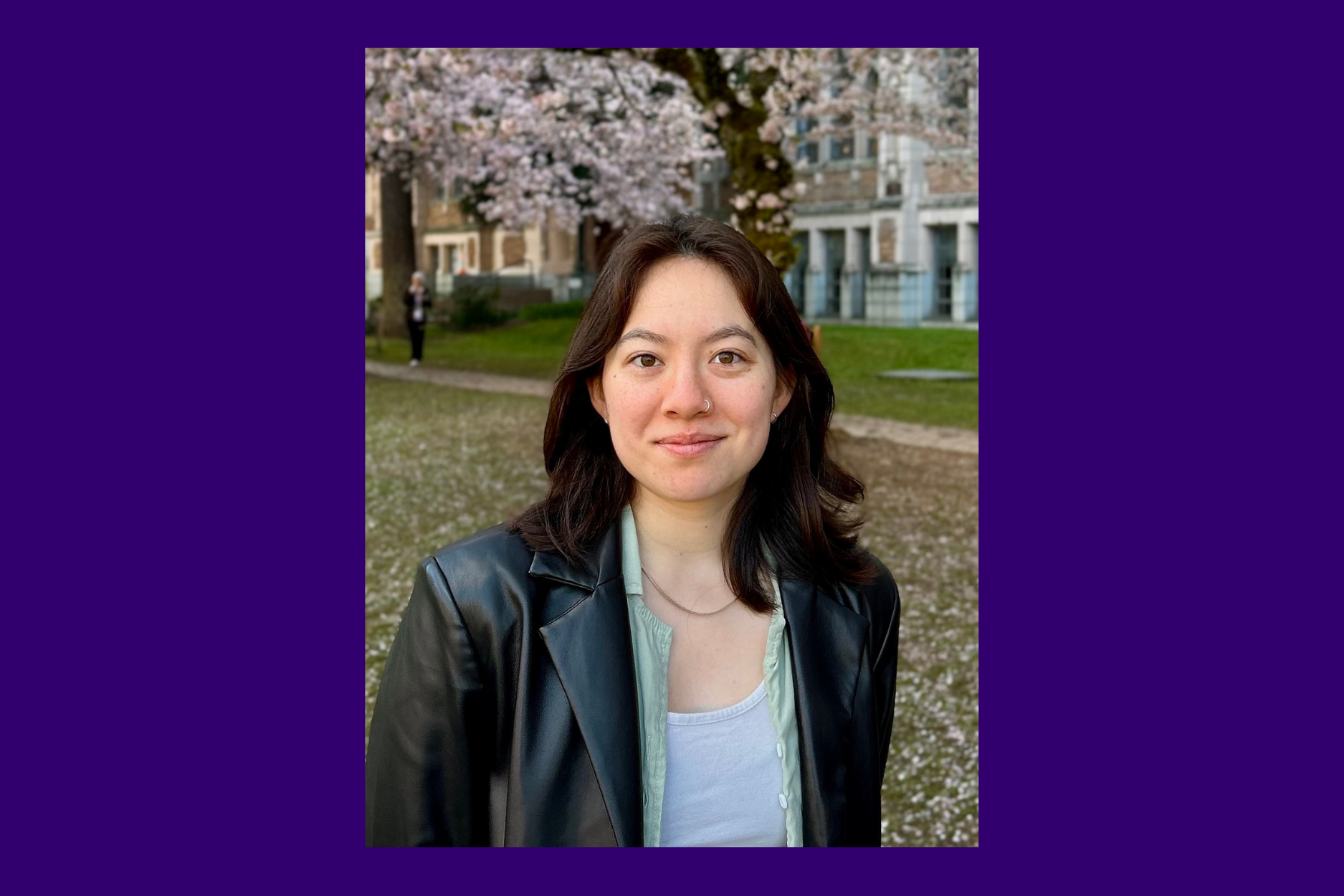
 UW Bioengineering PhD student Arie Lin-Goldstein earned an NSF Graduate Research Fellowship after years of hard work and valuable mentorship, while growing into an excellent mentor herself.
Arie Lin-Goldstein was in a University of Washington research lab before she was out of high school. A Seattle-area native, she hand-annotated images of the cells and synapses in macaques’ retinas with Professor Jay Neitz in UW Medicine’s Department of Ophthalmology.
There are different routes to a National Science Foundation Graduate Research Fellowship, which Lin-Goldstein earned in 2026. Grabbing time in Neitz’s lab when most students are grabbing their driver’s licenses must be a good start. Annually, only one in about 20 applicants receive the five-year grant.
The work with Neitz wasn’t just a job. “It was a great first step into an exciting world…It was part of a long-term goal that I had already been dreaming of,” she said. She even got to see some of her work included in a presentation at the 2023 Association for Research in Vision and Ophthalmology Annual Meeting.
Still, she found herself “out of breath” on her first day as an undergraduate in UW Bioengineering Professor Suzie Pun’s lab, her next step toward the Fellowship. “It was a big shift,” Lin-Goldstein said. “It was completely wet lab stuff, and I’d never used a pipette before. How do I even do this?”
She was a quick study. She also received terrific support from Pun and one of her graduate students, Abe Wu. “Their team is great at mentoring and great at supporting undergraduates,” she said. “Abe was always there when I said ‘Can you watch me do this one more time?’ He’s efficient but so patient.”
From there, it was a 10-week internship at the California Institute of Technology. As part of Caltech’s competitive WAVE program, Lin-Goldstein completed an independent research project. She studied engineered RNA sequences that protect the synthetic RNA against damage by enzymes.
Then she headed back to the Pun Lab to complete her bachelor’s degree, as a Mary Gates Research Scholar and a Washington Research Foundation Fellow. For her Senior Capstone project, a right of passage for UW Bioengineering undergrads, she worked on stablizing a DNA aptamer for treating autoimmune disease.
Aptamers are single-stranded DNA or RNA sequences that bind with the kind of high affinity and specificity that researchers usually expect to see in natural antibodies. Lin-Goldstein’s work required her to increase the stability of the aptamer once it was introduced, so that the white blood cells to which it attached were blocked from exiting the bloodstream and causing autoimmune responses
“Suzie really encouraged me to apply for the WAVE Fellowship. She is always looking for ways for everyone on her team to develop,” Lin-Goldstein said. And the senior capstone in her lab was “such a rich project. It’s amazing to have your own project like that as an undergraduate.”
Feedback, regulatory and otherwise
Lin-Goldstein is now part of Professor Paul Wiggins’ research team, studying the role of deoxynucleotide triphosphate (dNTP) levels in cellular homeostasis.
“Paul and his team have created a really nice environment,” Lin-Goldstein said. “We all have a lot of freedom, but we’re always in conversation with each other. We’re always gathered around the espresso machine and discussing what’s next and what angle we’re going to tackle it from.”
The dNTP metabolite’s relative abundance regulates the rate at which DNA replicates. Its own synthesis, meanwhile, is influenced by a host of other enzymes. This complicated brew of regulatory feedback keeps cells stable as outside conditions change by maintaining the appropriate levels of the metabolites the cell needs. It also creates oscillations in the speed at which a combination of enzymes and proteins at a region known as the “replication fork” do their work – unzipping DNA, copying its base pairs, and stitching it back together.
As part of her NSF Graduate Research Fellowship, Lin-Goldstein is exploring the underlying biological mechanism behind the oscillation in replication fork velocity. She will develop a quantitative model of regulatory feedback in the dNTP synthesis pathway and test it against experiments in bacteria. She’ll then use single-cell RNA sequencing to reconstruct the cell cycle and examine different metabolic pathways in greater detail. This work will demonstrate how different metabolic mechanisms impact replication fork velocity and cellular homeostasis overall.
“Arie’s project was inspired by a previous measurement the lab made [revealing] oscillatory dynamics in the speed with which the replication fork moves along the DNA. The most promising hypothesis, describing the mechanism, is that homeostasis, the process by which the cell maintains levels of essential metabolites, is … in fact oscillatory, in its behavior. Were this true, it would lead to fundamentally new insights into the nature of how homeostasis functions in the cell,” said Wiggins, who has a joint appointment in the Department of Bioengineering and the Department of Physics.
Those insights might ultimately help drive improvements in areas like drug resistance among patients who are being treated with antibiotics.
“What attracted me about Arie was that she had a really strong background in biology. Suzie Pun had great things to say about her, and I really respect Suzie,” said Wiggins. When he and Lin-Goldstein met for the first time, “I almost instantly decided that we clicked.”
More than the nitty-gritty
Lin-Goldstein continues to benefit from the mentorship of Wiggins and postdoc James Choi. She serves as a mentor herself, as well, helping Esther Shirakian learn the ropes.
The opportunity to work closely with Lin-Goldstein “connects several areas I want to grow in, including wet-lab experimentation, cellular biology, and reading scientific literature. Working with Arie has allowed me to build practical skills through hands-on experiments, while also learning how researchers evaluate papers, compare methods, and think through new experimental approaches,” Shirakian, a junior in the Bioengineering department, said.
Like her mentor, Shirakian is a quick study.
“Esther absorbs things very fast and is self-motivated. She’s always finding papers and new ideas on her own,” Lin-Goldstein said. Shirakian assists with culture preparation, optical density measurements, qPCR, and gel electrophoresis. Or, as Lin-Goldstein put it, “the nitty-gritty of growing cells and samples” that will likely be useful to Shirakian wherever her future takes her.
“It wasn’t that long ago, so I remember what being an undergrad was like, and I’m trying to emulate Abe in the way I was mentored then.” That mentorship goes well beyond the nitty-gritty of lab work.
“I appreciate that Arie includes me in the reasoning behind the research. When an experiment does not go as planned, she talks through the troubleshooting process with me and asks for my thoughts on what may have happened or what we should try next,” Shirakian said.
“That combination of independence, guidance, and genuine investment in my growth is what makes working with Arie so valuable.”